
Apr 29, 2026
What is the aperture value (f-number)?
What is the aperture value (f-number)?
A comprehensive explanation with example settings and the relationship between aperture, shutter speed, and ISO
The aperture value, also known as the f-number, plays a central role in taking an appealing photograph. It significantly affects how bright an image appears and how strongly the background is blurred (bokeh).
For different shooting situations – from portraits and landscapes to astrophotography or sports – there are suitable aperture values in each case. Anyone who masters aperture control can intentionally create impressive images. In this article, we explain in detail how f-numbers work, how they affect photos, and which settings are suitable for different subjects.
What is the f-number (aperture value)?
In photography, the f-number (F-value) is an important parameter used to control the amount of light entering the camera and the intensity of background blur.
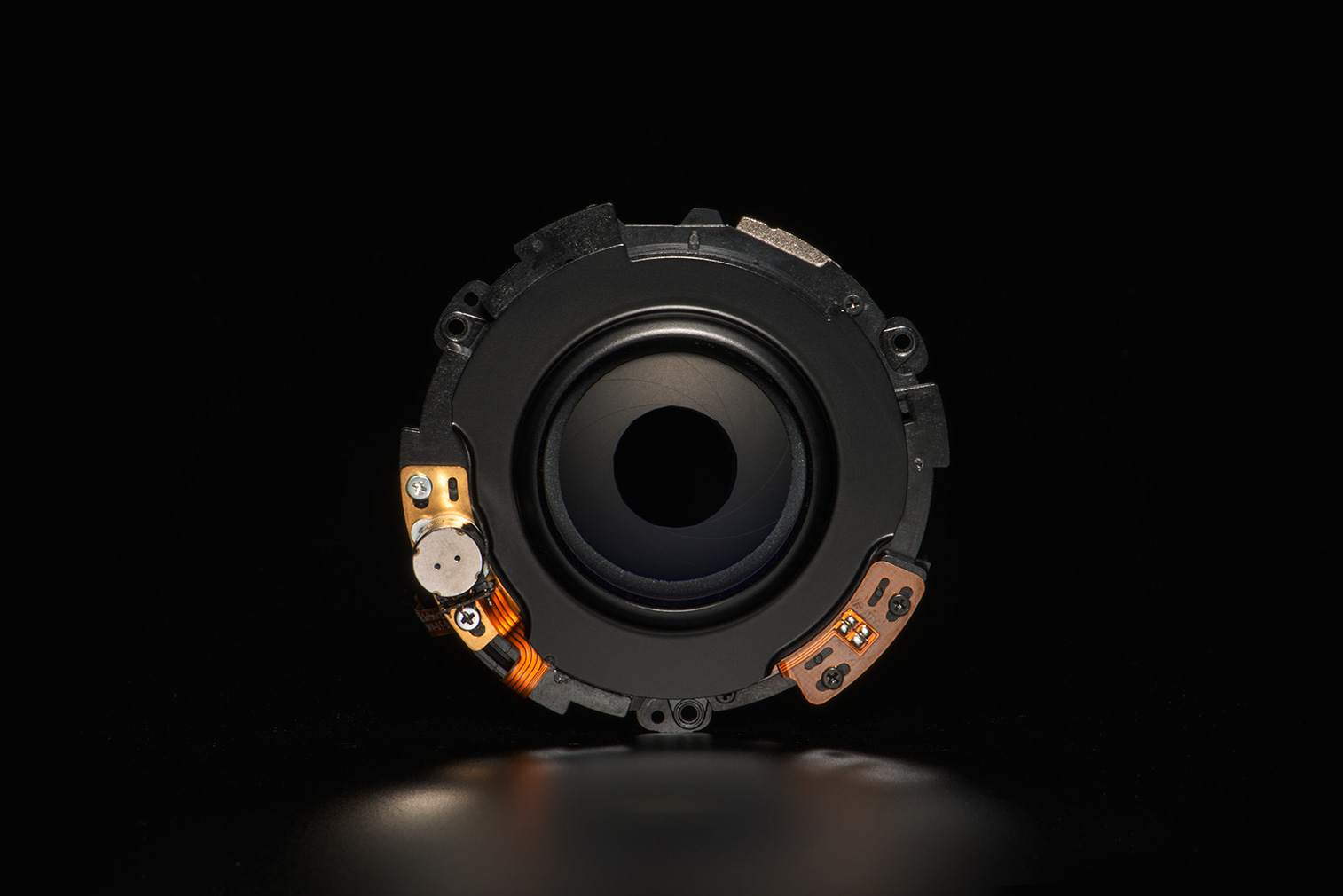
The aperture inside the lens opens or closes to regulate how much light reaches the sensor. The numerical values that describe this opening are called f-numbers or f-stops.
The f-number is calculated by dividing the focal length of a lens (f) by the diameter of the effective aperture opening (D):
F = f / D
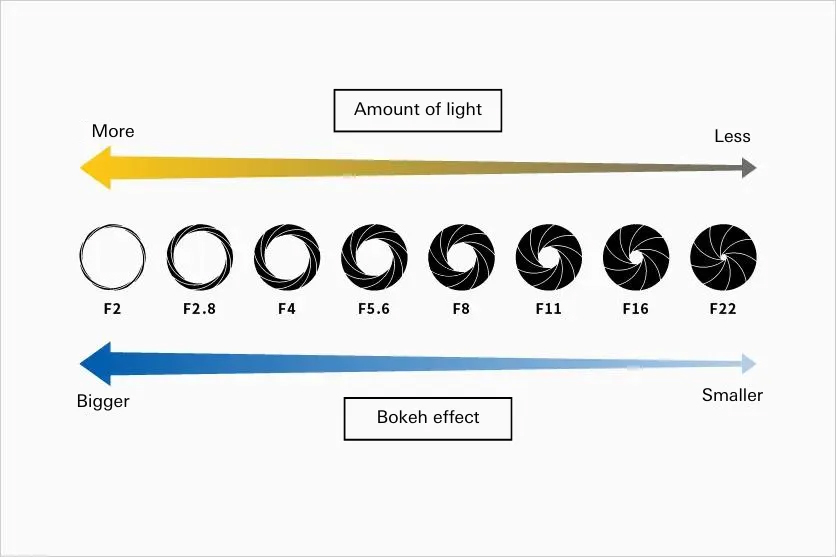
When the f-number is small, the aperture opening is large. This allows more light to pass through the lens.
When the f-number increases, the aperture becomes smaller, and less light reaches the sensor.
In addition, there are different aperture shapes, such as polygonal and circular diaphragms. A circular aperture produces a more pleasing and even bokeh, especially with small light sources like streetlights. For this reason, many lenses use multi-blade aperture designs to create as round a blur shape as possible.
Why is the f-number important?
The f-number (aperture value) describes the light-gathering ability of a lens and is one of the most important settings in photography.
To achieve a correctly exposed image, the shutter speed must be adjusted according to the chosen f-number. At the same time, the aperture also influences the strength of the bokeh (background blur) effect.
Example:
In dark environments or at night, a lens with a small f-number makes photography easier because it can collect more light.
This allows you to use:
faster shutter speeds to avoid motion blur, or
a lower ISO setting, which improves image quality.
Conversely:
With large f-numbers, less light reaches the sensor.
Therefore, you must either:
use a slower shutter speed, or
increase the ISO value.
However, a longer shutter speed increases the risk of camera shake, while high ISO settings can introduce image noise.
What does maximum aperture (wide open aperture) mean?
The f-number at the fully open aperture is called the maximum aperture or wide open aperture.
In this state, the lens allows the maximum possible amount of light to pass through. The larger this maximum opening is (i.e., the smaller the f-number), the better the lens is suited for:
low-light photography
strong background blur (bokeh)
Especially in dark scenes or fast-moving situations, this high light-gathering capability is a major advantage, because it allows faster shutter speeds and more flexible exposure settings.
What effect does the f-number have?
The chosen aperture value (f-number) can significantly change the look and mood of a photograph.
Small f-number → more bokeh (background blur)
Large f-number → less bokeh (more in focus)
This effect is related to depth of field, which describes the area in an image that appears sharp.
Small f-numbers create a shallow depth of field. Only a small part of the image is in focus, while the background appears blurred.
Large f-numbers create a deep depth of field. More elements in the scene are sharp at the same time.
By understanding how the f-number affects depth of field, you can deliberately decide which parts of an image should be sharp or blurred, giving you more creative control over your photos.
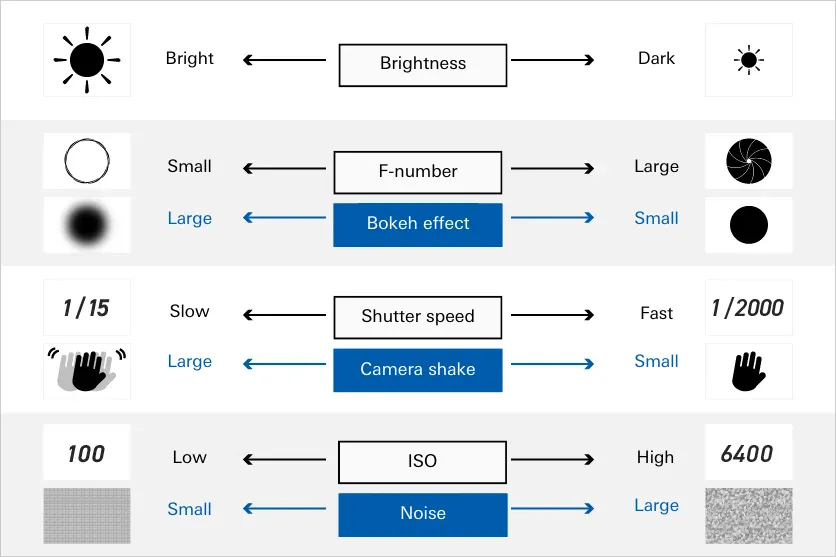
Aperture (f-number), shutter speed, and ISO
When taking photos, it is helpful to understand how aperture, shutter speed, and ISO work together.
Small f-number:
More light reaches the sensor
Faster shutter speeds are possible
Lower ISO values can be used
This helps reduce camera shake and image noise. At the same time, the background becomes more blurred, making the main subject stand out more clearly.
Large f-number:
Less light reaches the sensor
Slower shutter speeds or higher ISO values are required
A slower shutter speed can lead to motion blur or camera shake, which is why a tripod is often useful. Higher ISO settings, on the other hand, increase image noise, so maintaining a good balance between all three settings is important for optimal image quality.
Shooting in “Aperture Priority” mode
Many cameras offer an aperture priority mode (usually labeled “A” or “Av”). In this mode, you choose only the desired f-number, while the camera automatically sets the appropriate shutter speed.
This is especially useful when you want to intentionally control the amount of background blur (bokeh).
In general:
Large f-number → slower shutter speed
Small f-number → faster shutter speed
If camera shake becomes a problem, it can be helpful to choose a smaller f-number, because it allows a faster shutter speed, which reduces the risk of blur from movement.
Lenses with constant aperture (constant f-number)
With many zoom lenses, the maximum aperture changes when you zoom in or out. The further you zoom into the telephoto range, the larger (higher) the f-number usually becomes.
Lenses with a constant aperture, however, maintain the same maximum f-number throughout the entire zoom range.
Advantages:
Shutter speed and ISO are easier to control
Exposure remains consistent while zooming
The same amount of light is available even in the telephoto range
This makes it possible to capture sharp images with attractive background blur (bokeh) without having to significantly increase the ISO. For this reason, such lenses are often preferred by professional photographers.
The right f-number for different subjects
There is no single aperture value that is ideal for every situation. The result always depends on the subject, environment, and camera settings.
However, if you consider what visual effect you want before taking the shot, you can choose the appropriate aperture more quickly.
Examples:
Isolating the subject → small f-number
Sharp image throughout → large f-number
Below you will find typical aperture values for different genres of photography.

Best aperture for portraits
A key appeal of portrait photography is highlighting a person by using a blurred foreground and background.
For this, it is recommended to shoot close to the maximum aperture (wide open).
Typical values:
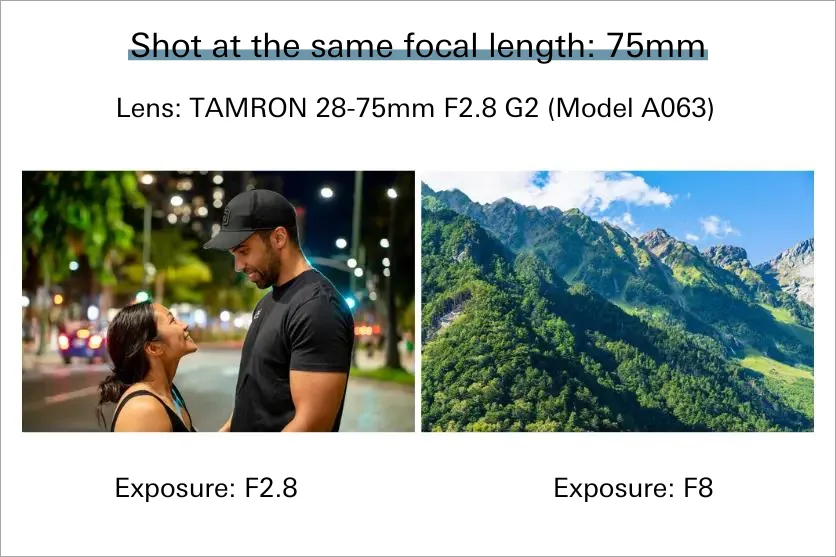
f/2.8 for standard zoom lenses
f/1.4 for prime lenses (fixed focal length lenses)
These settings enhance the bokeh effect, making the subject stand out clearly from the background and creating a more professional, visually pleasing portrait look.

Best aperture for landscape photography
In landscape photography, the goal is usually to capture as much detail as possible throughout the entire image.
For this reason, photographers often choose a smaller aperture opening (larger f-number) to increase depth of field.
Typical values:
f/8 to f/11
With these settings, both the foreground and background remain sharp and clearly visible.
However, you should avoid using too large f-numbers. At very small aperture openings (e.g., beyond f/16), diffraction effects can occur, which may lead to a noticeable loss of sharpness in the image.
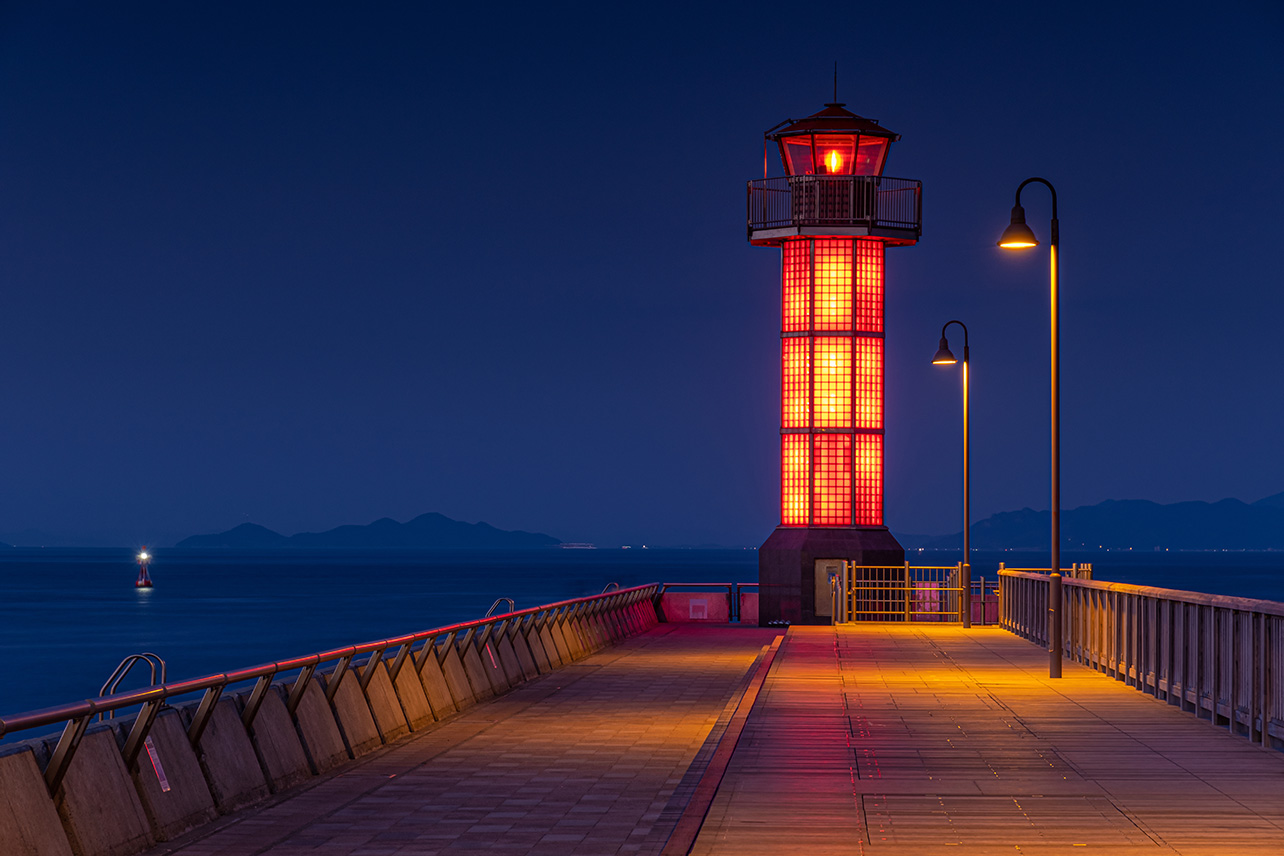
Best aperture for night photography
In night photography, similar to landscape photography, a high level of detail is usually desired.
For this reason, photographers often use values between:
f/8 and f/11
However, ISO and shutter speed play an even more important role here. Since there is less available light, you must either:
use a slower shutter speed, or
increase the ISO value
A tripod is highly recommended to prevent camera shake, especially when using longer exposure times.

Best aperture for astrophotography
To capture the Milky Way or stars, photographers usually use a very wide open aperture.
Typical values:
f/2 to f/2.8
This allows as much light as possible to reach the sensor, making stars appear brighter and more clearly visible.
However, with long exposures you need to consider that the Earth’s rotation causes stars to move, which can lead to star trails. For this reason, experimentation with ISO, shutter speed, and aperture is often necessary to achieve the best results.

Best aperture for sports photography
Sports events—such as children’s or school competitions—offer many opportunities for dynamic, memorable photos.
In this type of photography, it is important to:
keep multiple subjects in focus at the same time
avoid motion blur
Recommended settings:
f/4 to f/8 (slightly stopped down aperture)
This increases depth of field, helping more of the scene stay sharp, while still allowing enough light to enter the camera.
In addition, using a higher ISO setting and fast shutter speeds helps to freeze fast movement and capture sharp action shots.
Conclusion: Better photos with the right f-number
Many factors influence the final look of a photograph, but one of the most important is the aperture (f-number).
What really matters is the interaction between aperture, ISO, and shutter speed. When you consciously combine these three settings, you can get the best out of any shooting situation.
So it’s worth experimenting with different f-numbers and camera settings—this is the fastest way to understand which combinations best match your desired photographic style and creative vision.
